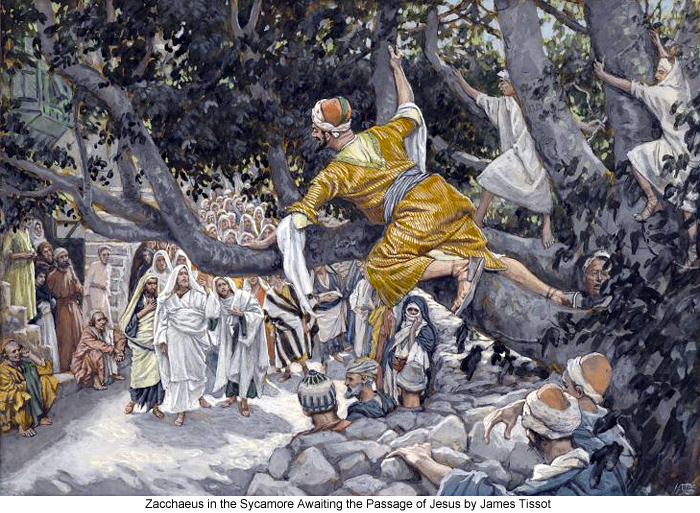
Musings: Zacchaeus
Most of our congregations will celebrate All Saints this Sunday, but I wanted to look at the ordinary lessons for the twenty-first Sunday after Pentecost. Because of the way we celebrate the two commemorations of the Reformation and All Saints; by moving them to the nearest Sunday, we consistently miss out on some interesting readings appointed for those ordinary Sundays.
This week, the appointed gospel is Luke 19:1-10, the story of Jesus and Zacchaeus. Most of us remember this story from our Sunday School lessons where we might have learned the song:
Zacchaeus was a wee little man,
And a wee little man was he.
He climbed up in a sycamore tree
For the Lord he wanted to see.
And as the Savior passed that way
He looked up in the tree,
And he said, “Zacchaeus you come down, For I’m going to your house today!”
For I’m going to your house today!
I imagine the song is memorable to children in part because we can understand how Zacchaeus felt when he could not see over the crowds. We remember how we need to climb onto the shoulders of our parents to watch a parade.
The song captures much of the first part of the story but leaves out that Zacchaeus was a chief tax collector and very rich, and as we read on, we realize that his position is very important to the story. As a chief tax collector, Zacchaeus would have been among those looked upon with contempt by the pious folks. It is likely that he would have been seen as a cheat or a thief. Think about the parable of the Pharisee and the tax collector in the previous chapter (the readings for Reformation Sunday supplanted this text). The Pharisee gives thanks that he is not like other people, including “this tax collector,” whom he lumps in with thieves, rogues, and adulterers.
When Jesus goes to the house of Zacchaeus for dinner, many in the crowd grumble that he has gone to be the guest of a sinner. By this we can see that much of society has written Zacchaeus off as a lost cause, even though he is apparently one of their people. Jesus, on the other hand, very deliberately singled out this sinner as one deserving of grace, not for what he had done but because he also is beloved by God.
I wonder what it would mean for us to seek out those among us who have been shunned by society, written off as lost. In the gospel for All Saints (Luke 6:20-31), Jesus gives a glimpse of what we might expect when we share God’s grace:
“Blessed are you when people hate you, and when they exclude you, revile you, and defame you on account of the Son of Man. Rejoice n that day and leap for joy, for surely your reward is great in heaven; for that is what their ancestors did to the prophets.”
In contrast to those who would proclaim a gospel that promises us power over others, Jesus presents a gospel of power hidden in weakness—“The message of the cross is foolishness”, says Saint Paul. It seems the best evidence that we are living our faith comes in the form of rejection and persecution.
Jesus never said it would be easy to follow him. Instead, he promises the way of the cross, the way of suffering, the way of rejection and abuse. Sometimes it looks like people grumbling: these people welcome sinners and eat with them. And sometimes is looks like crucifixion. Those who wish to follow Jesus cannot shy from these.
Related Posts