Bp Miller’s Musings: The Transfiguration of Our Lord
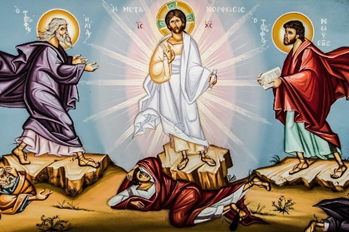
For those who use a lectionary book for the readings this week, you might miss the first few words in the gospel text. Omitted in my lectionary, these words make a clear connection to the reading from Exodus that might help us in our exploration of the presence of Moses at the Transfiguration.
The words omitted are, “Six days later…”, or as in another translation, “And after six days…”. The first question we might ask is, “What happened six days prior to this event?” Looking back to the previous chapter, we see there that Jesus has his confrontation with Peter who, after proclaiming so eloquently— “You are the Messiah, the son of the living God”—rebukes Jesus for speaking about his suffering and death— “by no means shall this happen to you.” Jesus in turn rebukes Peter— “Get behind me Satan.”
Six days later (or as written in the Exodus story, “on the seventh day”), Jesus ascends the mountain with Peter, James, and John. These few words remind us first of the sabbath, a day for reading and studying the law and commandments (Torah and mitzvot) of God. Sabbath rest brings remembrance of creation (“and on the seventh day, God rested”) and of God’s liberating act that freed a people from bondage in Egypt. The latter includes forty years of wilderness wandering during which God gives instruction, “the law and commandments”.
Within the Exodus story, in the text appointed for this day, Moses ascends the mountain (Mt Sinai) where he waits six days as the glory of the Lord descends in a cloud. On the seventh day, God calls to Moses to enter the cloud, wherein he receives the specifications for construction of the tabernacle and ark in which the tablets of the law will be kept and is given those same tablets.
Thus, it seems, the story of the Transfiguration is also a story of God giving instruction to the people, this time through “my Son, the beloved.” Just as the people who would become Israelites were to listen to Moses, the disciples are told to listen to Jesus. I can’t help but think that God’s command hearkens back to six days prior when Jesus spoke of his suffering and the suffering of those who would follow him.
We do well to listen more closely to Jesus, who did not come to abolish the law but to fulfill it. How do we, who are called by the Holy Spirit to become the body of Christ, continue to fulfill God’s instruction as interpreted by Jesus? Jesus says, “If any want to become my followers, let them deny themselves and take up their cross and follow me.” For Jesus, the cross means suffering for the sake of the world: so for us, our cross must mean suffering for the sake of others—the poor, the hungry, those who mourn, the stranger and refugee, those who are persecuted, and any others who cannot overcome the trials of this world.
We begin the season of Lent this week, a season of repentance. Let us consider what repentance means in light of the command on the mount of Transfiguration to listen to Jesus.
Related Posts